
What Would Not Leave
Awakening moments do not remain suspended in time.
Life resumes, responsibilities grow, and what once felt clear —
becomes something carried quietly within.
Though I returned to ordinary routines,
the feeling I discovered in the mountains —
never fully left me.
After Yosemite, I did not immediately pursue photography.
Life moved forward the way life does.
I continued hiking each year with the same friend I had gone with before, quietly hoping to feel again what I experienced standing at Glacier Point. I didn’t know exactly what I was looking for — only that something in me remembered it.
During those years I married, had two children, bought a house, and worked at a factory. Money was always tight. Life was full, but inwardly I still felt drawn back toward the mountains.
I took my wife and children camping and backpacking when I could, though I sensed the mountains spoke to me differently than they did to her. The pull never really left.
In my early twenties I asked if we could afford a 35mm camera. It felt like a small request, but to me it was important. I began photographing my wife and children, the places around where we lived, and anything I encountered while hiking. I was taking college classes part-time of various subjects, searching for something that might hold my interest or direction.
I returned to the mountains whenever I could, always carrying a camera. I tried to capture what I saw in lakes, rivers, trees, and waterfalls — hoping the photographs might hold something of what I felt there.
Life changed again when my marriage ended at the age of twenty-eight. The divorce was difficult and occupied much of my thoughts for several years.
I remember the song by John Denver where he sings, “he was born in the summer of his 27th year, coming home to a place he’d never been before.” I felt something similar — as if I had been born again, once at fifteen standing at Glacier Point, and now again at twenty-eight and alone.
During that time I began to recognize how important the mountains were in my life, and how photography allowed me to hold those experiences in a tangible way. Photography was no longer just something I enjoyed — it became a way to steady myself and relate more quietly to the world around me.
I began taking every photography class offered, except photo-journalism, sometimes repeating them. I wanted to understand what I was seeing and feeling when I made an image. In portrait classes I learned to interact with people on a more personal level.
Photographing others created moments of connection I had deeply missed, my own inner life became more important to me as well.

Photography classes introduced me to composition, different films, and the process of developing and printing black-and-white images in the school lab. For the first time I saw how an image slowly appeared in the developer tray — almost emerging from nothing.
Photographing people taught me patience.
I began to notice a presence in the people I photographed
I learned to wait. At first they posed for the camera, but after a while they would relax, forget themselves, and simply be present.
That was the moment I pressed the shutter — when who they were began to show.


Photography Class Portraits 1988
My biggest struggle was exposure. I learned that a good print began with a good negative, and over time experience taught me how to see light more carefully. I often carried a tripod because the film I preferred was slow and fine-grained, requiring patience and stillness.
I also began to see beauty not only in the natural world but in the people around me. My photography teacher recommended The Wisdom of Insecurity by Alan Watts, and in a psychology class I listened to a recorded lecture by Ram Dass. These experiences, along with meditation and repeated visits back to Yosemite and the mountains, deepened my interest in understanding myself and the world more fully.
At the same time, I became increasingly focused on creating a technically sound image. The school offered both medium and large format cameras, and I remember checking out a 4×5 view camera and traveling to the ocean at Point Reyes. The process was slow and demanding, requiring careful preparation for a single exposure. After all that effort, I returned with only one acceptable negative, but the experience — and time spent in those wild places — stayed with me.
When I was photographing, time seemed to move differently.

The desire to understand myself, the draw toward nature, and the need to capture moments that carried the feeling of a place began to merge into one pursuit.
I was no longer just looking at places — I was learning how to be present within them.
While visiting Yellowstone, I noticed another photographer working with a medium-format camera. I eventually found a professor selling a 6×7 camera and began using it exclusively. The larger negative produced a depth and clarity I had been searching for, similar to the postcards I remembered from Yosemite.
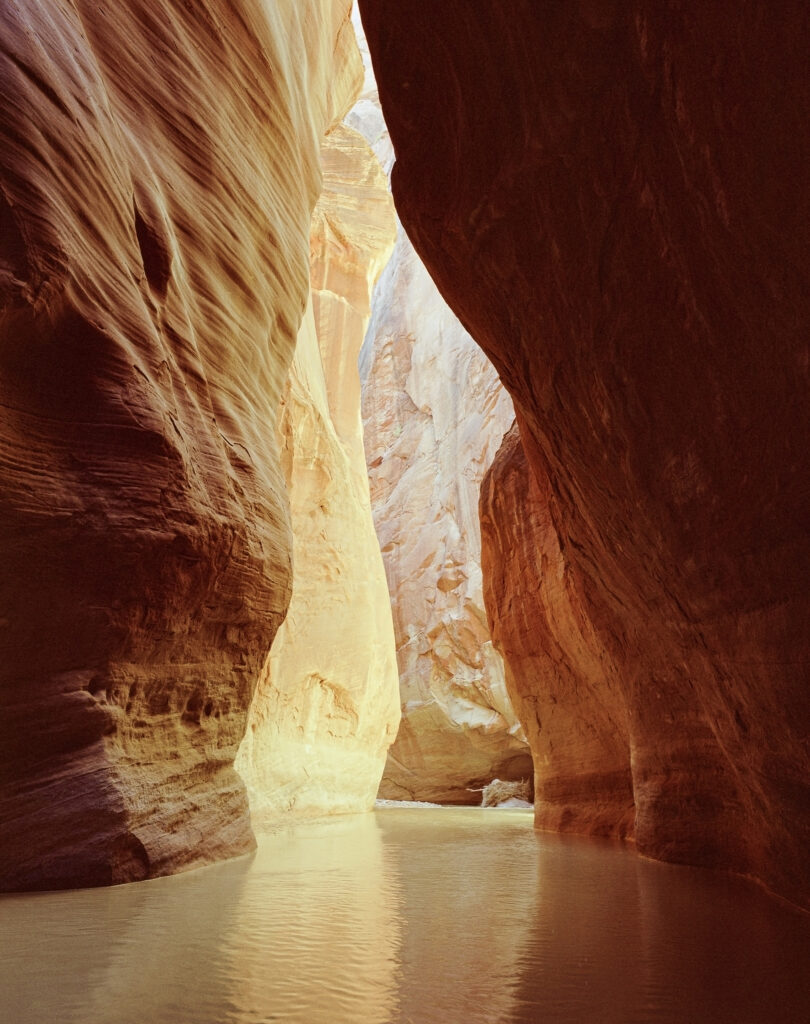
Working with that camera changed my pace. It required thought, patience, and attention. The weight of the equipment and the need for a tripod slowed everything down, forcing me to pause, observe, and become fully present with what was before me.

I realized photography had quietly become necessary to me. It allowed me to notice beauty in the people I photographed, a reason to return to the mountains, and a way to reconnect with the peace and awe I had first felt years earlier at Glacier Point.
I wasn’t chasing photographs anymore.
I was learning how to really see.